Wednesday, January 14, 2026

Daring to Call God Father!

 See related image detail. How Can I Call God Father? | Draw Nigh To Hope

A doctor of Biblical Literature from the Inchon Diocese, in the Catholic Times, offers some reflections on ways to sanctify the name of the Lord God as presented in the Old Testament and Jewish literature.

First, it is said that the people of Israel (the believers) sanctify God’s name by keeping His teachings and commandments when following the teachings of the scribes or rabbis. “You must keep my commandments and follow them. I am the Lord. Do not desecrate my holy name, so that my holiness may be revealed among the Israelites. I am the Lord who sanctifies you.” (Leviticus 22:31-32)

Second, it can be noted that the salvation of humanity is to be fulfilled and proclaimed by the prophets. By revealing Himself as the righteous judge and the completer of salvation before all nations, the Lord God manifests His own holiness. “I will sanctify the great name which you have profaned among the nations.” (Ezekiel 36:23)

Saint Bruder Klaus (1417–1487) of the Swiss Church offered only the Lord’s Prayer during his pilgrimage from his hometown to the Einsiedeln Benedictine Monastery, about 50km away. How many times did he offer it? It is said that he could not even complete it once.

It is astonishing yet understandable. When praying while contemplating the profound meaning contained in the Lord’s Prayer, one might feel as if they remain in that first line for a very long time. How can we humans, “a fleeting smoke that appears and vanishes” (James 4:14), dare to directly call our Creator God ‘Father’? Saint Klaus probably found that even a ten-hour meditation could not fully grasp such a profound mystery.

The Lord God Himself has shaped us. Being born into the world through our parents is, in fact, the greatest mystery and grace on earth. How can one understand even 10% of the mystery of life, of the one and only me created uniquely in the entire universe, in just a few hours?

As a penance for confession, he sometimes suggested to the parishioners, “Would you like to slowly offer the Lord’s Prayer while reflecting on its meaning? Or would you like to devote yourself to the Rosary?” Some people respond, “I pray that every day,” giving the impression that they regard the Lord’s Prayer or the Rosary as not particularly significant. 

He encouraged the parishioners reading this to listen attentively to the words of salvation from Ezekiel 36 whenever you offer the Lord’s Prayer. I believe that His blessing is already blooming abundantly within us. “Thus says the Lord GOD: On the day I cleanse you from all your sins, the towns shall be inhabited again, and the ruins shall be rebuilt. … And the people will say, ‘The land that was desolate has become like the Garden of Eden…’”

Monday, January 12, 2026

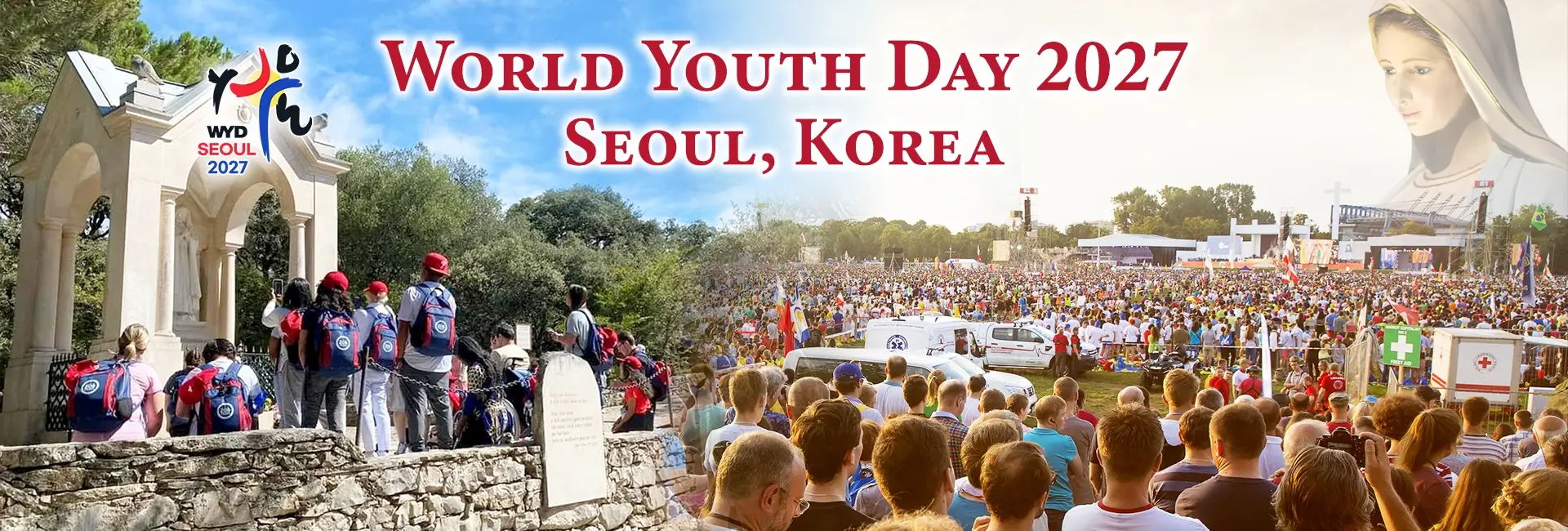
World Youth Day, Korea 2027

2027 World Youth Day Seoul, South Korea with 206 Tours - Catholic ...
 

The Korean Catholic  newspapers reported the interview with Cardinal Américo Aguiar,  2023 Lisbon WYD Organizing Committee Chair, in Seoul Korea on December 21st. "WYD Seoul 2027’ will be the greatest ever… We must spread the word about WYD boldly until the very end.”

“Young people around the world are showing great interest in Korea. That’s why I am confident that the 2027 World Youth Day (WYD) in Seoul will be the greatest ever. Young visitors to Korea will become ‘witnesses’ who testify about what they experience in this country.”

Cardinal Américo Aguiar, former Chair of the 2023 Lisbon WYD Organizing Committee, visited Seoul on December 21. He came to observe the Korean Church’s preparations for WYD firsthand and to share his experiences as an organizing committee chair.

Cardinal Aguiar said, “The global community is paying attention to the upcoming Seoul WYD because the Korean Church is a church built on the blood of martyrs and started by laypeople,” adding, “Portuguese youth will also have the opportunity to visit Korea to see and learn how the Korean Church conducts youth and young adult ministry.”

Cardinal Aguiar also emphasized that laypeople need to actively participate in preparing the event. He stated, “As Pope Francis has consistently stressed, laypeople must play a central role in WYD according to the spirit of synodality,” explaining, “In the past, team leaders in the Portuguese Church were all priests, but in preparing for WYD, we encouraged laypeople’s participation, and more than 20,000 lay staff and volunteers played a key role in the event.”

He emphasized the importance of broad promotion of WYD. It is necessary to continuously and widely spread the fact that the Seoul WYD will be held. WYD is a festival for all young people. We must go and invite even those who do not know about this event until the very end.” 

 Cardinal Aguiar recalled that there were difficulties in generating social consensus in Portugal regarding hosting the event during the Lisbon WYD. He said, “There were even those who opposed holding the event in Lisbon itself,” and added, “But we kept explaining to them what this event was and what it meant, and by inviting them to the event instead, we broadened the consensus. Another challenge was that Pope Francis’ invitation needed to reach all young people,” and advised, “Because not everyone knows about the WYD event, it is absolutely necessary to promote Seoul WYD both technically and strategically even before the event begins.” 

Cardinal Aguiar also extended words of encouragement to the young people of the Korean Church preparing for Seoul WYD as the ‘next generation’ following Portuguese youth. “Preparing for such a large event requires bold courage. God will give the youth of Korea the strength to overcome difficulties. Like the theme verse of Seoul WYD, ‘Take courage; I have overcome the world’ (John 16:33), I hope you do not lose courage and walk together until the end.”

This is the second World Youth Day held in Asia but the first in a predominately non-Catholic Country. 


Sunday, January 11, 2026

Baptism of the Lord Jesus

 Colorful mosaic glass art of the Baptism of Jesus Jesus Christ baptism by Saint John the Baptist on an old stained glass window decoration in Sappada's Church (Belluno) Italy. Baptism Stock Photo

The Catholic Times featured an article on the Feast of the Baptism of the Lord: How Did ‘Water’ Become a Symbol of Baptism? This Feast Day also brings the end to the Christmas Season.
 

In the Old Testament, water is an element of life... in the New Testament, it takes center stage in the baptismal rite through John the Baptist.

The Feast of the Baptism of the Lord (January 11) commemorates the baptism of Jesus Christ by John the Baptist in the Jordan River. The Gospels narrate Jesus’ baptism as the central scene of this feast, testifying that through this scene, Jesus’ identity and mission of salvation were publicly revealed. 

On this day, the Church also reflects on the meaning of 'water' used in the sacrament of baptism. Water has symbolized creation, purification, and boundaries as a natural element, but through the event of Jesus’ baptism, it came to be understood within the Church as a sacramental sign revealing the grace of salvation. On the occasion of the Feast of the Baptism of the Lord, we explore how water came to be established as the symbol of the sacrament of baptism.

In the Old Testament, water is both a natural element that sustains life and a symbol that reveals judgment and boundaries. Genesis describes water over the chaos, with the Spirit of God hovering above it. In this passage, water serves as the backdrop, representing the state prior to creation.

In Exodus, the waters of the Red Sea are presented as a boundary prepared by God to allow the Israelites to move from slavery to liberation. The power that accomplishes salvation lies not in the water itself but in God’s action of parting the sea. When the prophet Ezekiel declares, “I will sprinkle clean water on you, and you shall be clean” (Ezekiel 36:25), water also serves as a means through which God expresses his promise to give a new heart and a new spirit.  

In the New Testament, water is central to the ceremony through the activities of John the Baptist. John proclaimed the baptism of repentance in the Jordan River and called for forgiveness of sins. However, John makes it clear that his baptism is not ultimate. "I baptized you with water, but He will baptize you with the Holy Spirit." (Mt 1:8) The decisive moment when water began to be understood as a sign of baptism was the baptism of Jesus Christ. The Catechism of the Catholic Church describes the baptism of Jesus as the event in which the sinless One became one with sinners and began his mission of salvation. In this way, water was originally an element of repentance and purification, but through Jesus's baptism, it became associated with the Paschal Mystery of Christ and a sign in the sacrament of baptism in the Church. This understanding is also directly connected to the lives of believers who are baptized with water. 

The Catechism of the Catholic Church defines baptism as "the sacrament of rebirth with water and the word." (It also emphasizes the sacramental union of believers to the death and resurrection of Jesus Christ. "He must humble himself and enter into the mystery of atonement, immersed in water with Jesus and then come up again with Him. Only then will you be born again in water and in the Holy Spirit, become God's beloved children in the Son, and live a new life."