Sunday, January 4, 2026

Just Anger

 1,900+ Jesus In Temple Stock Illustrations, Royalty-Free Vector ...


Anger that follows a righteous judgment made by proper reason is 'good.' A philosophy professor in the Catholic Times presents the thoughts of St. Thomas Aquinas on what is meant by Just Anger.
 

These days, the news frequently reports crimes that are difficult to understand, caused by 'anger.' There have been instances where people, filled with rage, have taken weapons to the streets and attacked complete strangers with knives. Anger toward neighbors due to noise between floors can even escalate to murder.

Looking at similar incidents, one might agree with some ethicists who view the inability to control anger as a kind of disease or who claim that 'anger is a flaw and therefore cannot contribute to a virtuous life.'
 

This raises the question: does anger harm human happiness, or can it also have a positive side for our well-being? Is suppressing anger always virtuous, or only sometimes?

Thomas Aquinas' theory on anger provides a framework for answering these difficult questions. Moreover, it offers insight into “for what, how, and to what extent one should be angry.”

Even Christ was angry when He purified the temple (see Matthew 21:12-13). This anger arises not from wounded emotions but from love for justice and piety. However, using anger for its own sake gives rise to many vices and sins.
 
Thomas defines anger as 'the desire for revenge (ira est appetitus vindictae).' Anger, however, arises not from trivial matters but from 'important matters,' that is, when one experiences significant and grave evils. Anger is the impulse of the heart to retaliate for the wrongs suffered, and within it lies a dual purpose: to defend the good that one desires, hopes for, and enjoys, and at the same time to demand reparation for the injury received, hoping that the evil will be repaid. 

However, just because anger is accompanied by reason does not mean that anger always obeys reason. Therefore, Thomas says, "Anger more clearly obstructs the judgment of reason more so than other passions do". 

 Anger varies according to each person's temperament and can disturb the mind and whole body, making it comparable to fire. When anger intensifies, the blood boils, the heart races, and the tongue may even become immobile, causing stammering or blocking speech. Due to this physical and mental agitation, anger makes deep reflection, contemplation, and calm judgment very difficult. Rather than merely suppressing anger, it should be used for justice and love. When it aims at disorderly revenge, it becomes unjust and a source of sin, turning otherwise righteous anger into sinful anger. 

 However, Thomas does not view anger as inherently immoral. Anger can be just or unjust. In fact, since it arises from the desire for rightful revenge against an unjust act, anger is closer to justice (iustitia) than to injustice (iniustitia) (I-II,46,7). When anger arises under proper control of reason and constitutes 'rightful revenge,' it is regarded as an expression of the virtue of justice. Conversely, when anger aims at disorderly revenge—acting outside legal order in a private manner, or seeking to destroy and annihilate the wrongdoer rather than address the sin—it becomes sinful. 

Because of this issue, Thomas considers anger one of the seven deadly sins and analyzes how various vices, such as quarrels, cursing, and violence, flow out of it. When appropriately managed, anger becomes a fire that burns for justice, but if left unchecked, it becomes the 'mother of vices,' producing many sins. 

Furthermore, Thomas sees the state of witnessing injustice without any response as yet another vice. He explains the lack of movement corresponding to a just cause—the absence of the will to punish—as a vice of deficient anger. In other words, it is a failure to feel anger where it should be felt. Justified anger and sinful anger

However, Thomas does not see anger as a sin unconditionally. Anger can be just or unjust. Rather, because they want just revenge for an unjust act, anger is closer to justice (iustitia) than to iniustitia (injustice). (I-II,46,7) If anger arises under the proper control of reason and is 'just revenge', it is considered to be the virtue of justice.

On the contrary, when anger is directed towards disorderly revenge - when it tries to punish in a private way outside the legal order, or when it seeks to destroy and annihilate the sinner instead of sin, Thomas sees anger as one of the capital seven sins and analyzes that various bad habits such as quarrels, curses, and violence flow from rage. When anger is dealt with justly, it becomes a fire that burns for justice, but when left unattended, it becomes the 'mother of bad habits' that gives rise to many sins.

Furthermore, Thomas sees the state of seeing injustice and not making any movement as a bad habit. He explains the lack of movement corresponding to the feeling of a justifiable cause, that is, the lack of will to punish, as a bad habit called the lack of anger. In other words, not being angry at all where you should be angry, and being insensitive in the face of fire is morally wrong.

Based on this reflection, Thomas says that hatred (odium) is much worse than anger. This is because hatred wants evil in itself, but anger wants evil in the 'good of just revenge'. The justly angry man at least puts forward the name of justice, and the punishment inflicted on him may be for the common good in a sense. On the other hand, hatred is a more evil passion than anger, because it seeks no good from the other person.

Thomas acknowledges 'righteous and commendable anger aligned with right reason.' Anger that precedes reason and disturbs it is evil, but anger that follows and aligns with the just judgment of reason is good and can be meritorious. Such anger can also manifest in struggles for the Church's common good, social justice, and the protection of the weak. Christ Himself was angry when He purified the temple (see Matthew 21:12-13). This kind of anger arises not from wounded feelings but from love of justice and piety. When anger is used for justice and love, it becomes an aid to virtue. 

However, if anger is used merely for revenge, it becomes one of the seven deadly sins, giving rise to many vices. Believers should not merely deny or suppress their anger but should examine where their anger comes from, what sense of justice and what wounds provoke it, and then transform it into a force for justice and love.

Friday, January 2, 2026

Philosophical Counseling: Transcendence

 Money and Spirit - Edward Mannix

In the Armchair Philosophy column of the Catholic Peace Weekly, the professor offers a brief explanation of the 'transcendence technique' in philosophical counseling.

When teaching the transcendence technique in philosophical counseling, misunderstandings are common. Some people consider the transcendence technique a religious counseling method that heals individuals by relying on an absolute being. However, the transcendence technique is unrelated to this; rather, it is a distinct method of philosophical counseling that heals individuals by drawing on fundamental philosophical insights into human nature, life, and existence.

Essentially, it is based on the philosophical insight that humans are free beings who define themselves, solve life’s problems through self-transcendence grounded in the 'transcendence of the mind.' The core of the transcendence technique lies in human nature’s 'transcendence,' which arises primarily from the 'freedom' and 'openness' of the mind. Humans are not complete beings but beings moving toward completion; through life, they realize themselves, and in this process, they experience transcendence by continuously redefining themselves within a free mind.

The essence of the transcendence technique is not to pursue supernatural or idealistic ultra-realities. Instead, it lies in the
'transcendental experience' where humans, despite being finite, continuously surpass their limitations through their minds. The characteristics of the transcendence technique are most evident in the human spirit and in life’s dynamics, which continually strive to transcend limiting conditions rather than submit to them.

The dynamism of the human mind is fundamentally based on the innate 'questions' that drive the pursuit of knowledge. As spiritual beings, humans seek epistemological alignment with the world through constant questioning. Through this process, we fundamentally arrive at the recognition of truth. In the transcendence technique, however, the question serves as the beginning of healing and becomes a method in itself. The questions in the transcendence technique are not limited to an epistemological level of merely satisfying curiosity; they aim at a deeper, more fundamental dimension of healing. 

In other words, these questions constitute a fundamental act of understanding for healing, grounded in the absolute affirmation of existence and its horizon of meaning. So, what is the relationship between questioning and healing in philosophical counseling?

The triggering of a question begins with the fundamental recognition that one does not know. The spark of questioning begins with the 'knowledge of ignorance,' an intuition that one fundamentally does not know. So, when exactly do we realize that we do not know? Socrates once drew attention to the maxim inscribed at the Temple of Apollo in Delphi, ancient Greece: 'Know thyself,' as a call to attain true wisdom. Fundamentally, we ask questions because we want to know, but the questioning of transcendental methods serves as both a starting point for healing and a process of healing in itself. This is evident in how we suddenly become aware of our ignorance and ask serious questions when confronted with fundamental problems in life, even though we usually live without conscious awareness of it. 

Such questioning is an act of healing, a way for us to overcome and transcend our own suffering and crises. When an event, situation, or object (including a person) approaches and unsettles us—or, particularly in relation to trauma and healing, when we are stranded in a limiting situation and completely lose our direction—we ask questions in an effort to reach understanding. Above all, these questions are directly related to the questions of one's existence, life, and its meaning.

Thursday, January 1, 2026

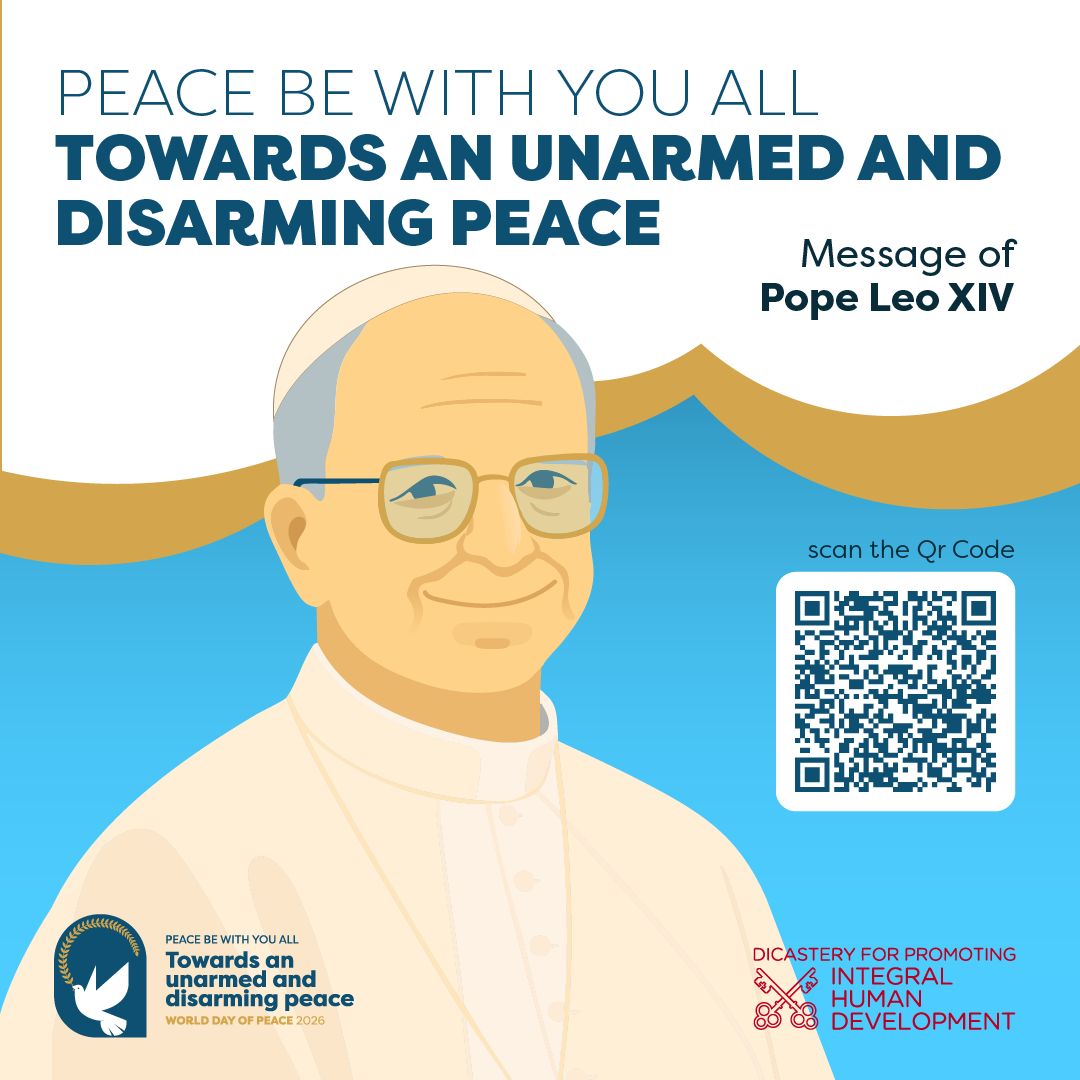
The Pope's Peace Message 2026

Message for World Day of Peace 2026
  Happy New Year

Emphasizing an Open Heart and Gospel Humility for Peace That Makes People Lay Down Their Arms
Pope Leo XIV released a message titled 'Peace Be With You All: Towards Peace That Lays Down Arms and Makes Others Lay Down Arms' on January 1, marking the 59th World Day of Peace. Since his election as pope on May 8, 2025, and on several occasions afterward, Pope Leo has appealed for world peace, often using the distinctive expression 'laying down arms and making others lay down arms.'

In this year's message, the pope proposed a peace that comes from laying down arms, that is, a peace not based on fear or threats, as well as a peace that makes others lay down arms, a peace that resolves conflicts, opens hearts, and fosters mutual trust, empathy, and hope. He also stressed that merely calling for peace is not enough; peace must be realized through a way of life that rejects all forms of violence, whether visible or structural.

The Peace of the Risen Christ
At the beginning of his message, the pope said, 'Christ, the Good Shepherd, who lays down his life for the sheep and embraces even those sheep who are not within us, is our peace,' and added, 'He conquered death and shattered the walls of division that separate humanity.' Contrasting darkness and light, he noted, 'The presence, gifts, and victory of Christ continue to shine through countless patient witnesses and, as God's work continues in this world, it shines even more clearly in the darkness of our times.'

In the message, contrasting peace with light and violence with darkness, the pope said, 'Peace resists violence and overcomes it,' and continued, 'Even amid what Pope Francis has called a ‘sporadic Third World War,’ those who make peace draw strength from this conviction to continue resisting the spread of darkness.

Wednesday, December 31, 2025

Learning to Be Old

See related image detail. Learn and Grow Symbol. Concept Words Learn and Grow on Brick Blocks ...

A professor in the Welfare Department of a Korean university offers readers of the Catholic Peace Weekly reflections on aging. 

Growth, aging, and death are natural developmental processes for humans. However, just as a child needs education and training to grow into a mature adult, even after becoming an adult, it takes significant learning and preparation to age gracefully into a wise senior.

Margaret Cruikshank emphasized in "Learning to Be Old" that aging is not merely a biological change but a dynamic process reconstructed within social and cultural contexts. Aging affects everyone, but outcomes depend on how individuals prepare for and adapt to it, as well as on the social norms and environments in which they grow older. Therefore, to age well, one must learn about aging.

In a super-aged society in which the elderly stage of life accounts for half of one's lifespan, early preparation and continued learning are needed to spend those long years actively and meaningfully. In the first volume of the "Gerontology in the Era of 100 Years" series, published earlier this year, the author's first question was, "Why gerontology?"

This can be summarized with three reasons. First, everyone is experiencing 'aging' due to increased life expectancy. Second, as the elderly stage of life becomes longer, its significance within life grows. Third, the final evaluation of a life inevitably comes from the perspective of the elderly stage. Therefore, failure in old age is not just half a failure; it can be considered a failure of the entire life. To spend the later years—and, more broadly, one's whole life—more meaningfully and productively, one must learn about older adults, understand aging, and prepare for old age. In this sense, gerontology is an essential subject for everyone living in the era of longevity.

So, what does it specifically mean to 'learn about aging'? Psychologist Erik Erikson defined adolescence as a crisis of identity. 'Identity' refers to the unique characteristics that determine one's existence and distinguish oneself from others. Humans continue to develop and change, thereby altering relationships with others and with society itself. 

So, what does it specifically mean to 'learn aging'? Psychologist Erik Erikson defined adolescence as a crisis of identity. 'Identity' refers to the unique characteristics that determine one's existence and distinguish oneself from others. However, humans continue to develop and change, altering relationships with others, and society itself is constantly evolving. Therefore, identity is not fixed or immutable; it changes over time as one grows older. 

Contrary to Erikson's claim, in old age, a second identity crisis can occur. William Sadler defined old age as a 'second period of growth' in his book "The Third Age: Thirty Years After Forty." This second growth is a transition to a new identity, starting not from the 'defined self' in workplaces, family, and social relationships, but from reflection on the 'life I truly want.' To establish a new second identity, deep self-reflection is essential. In old age, one must create a new 'self' in one's own way, not based on the 'socially constructed self.' One should ask and earnestly seek answers through introspection and sincere prayer, questioning what one truly likes, desires, and pursues. 

Old age is a period in which one must contemplate a new 'identity' to navigate the remaining half of life amid internal changes associated with aging and external societal changes. Ultimately, as we age, we must continually deconstruct and reconstruct our identities. This is the first step in learning to age. Happy New Year!

Monday, December 29, 2025

 38 Synod Logo Images, Stock Photos & Vectors | Shutterstock


In the Catholic Peace Weekly, the seminary professor in his column, The Preciousness of Faith, has some thoughts on our efforts to make Synodality a part of Catholic Life  

After the 16th World Bishops' Synod process, which took place over three years, has concluded, we have now entered its 'implementation phase.' However, within the Church itself, it is challenging to find renewal movements aimed at synodality. This is likely due to complacency, the belief that current approaches are sufficient, and a convenience-driven avoidance of the discomfort associated with change. Yet, if the universal Church has discovered the hope of the Church in synodality under the guidance of the Holy Spirit, it is now time to actively respond to providing direction in that regard.

If one were to sum up synodality in a single phrase, it would be 'a dynamic Church that collaborates, evangelizes, and grows together in communion.' The core of synodality lies in communal discernment. 'Dialogue in the Spirit' is a method that can be applied not only in synodal meetings but also in small community or organizational gatherings. It is a moment to heed the guidance of the Spirit revealed through the words and experiences of others, with the crucial task being the formation of 'consensus' among the members. Synodality encompasses the entire process of gathering to pray, listen, dialogue, form agreements, make decisions, and take responsibility.

Synodality is undoubtedly not an easy practice, because it requires taking the longer, more difficult path. It demands gathering together to pray, dialogue, listen attentively, exercise careful consideration, and lay aside one’s own thoughts to hear God’s will through others. The greatest challenge of synodality will likely be for bishops and priests since it requires listening, coordinating, and setting aside the desire to act according to their own will.

Synodality is not merely a decision-making method; it is a shared emotion, culture, spirituality, and practice. So, what does a synodal Church that embodies synodality look like in practice?
 

He recalls Father Louis-Marie Chauvet, who was his master’s thesis advisor during studies in France and served as the parish pastor. As an expert in liturgy and the sacraments, he visited his parish with the expectation that the Mass he celebrated would be somehow different.

Contrary to his expectations, the emotional impact of the Mass was not in the 'event' itself but in the 'quality' of the celebration, namely, the lively atmosphere of the parish community. It was a community where every member of the congregation made eye contact, exchanged smiles and greetings, and welcomed one another; where everyone focused attentively on the ceremony and participated; and where liturgical ministers collaborated with the priest to ensure that the holy Mass was celebrated beautifully, encouraging and taking care of each other—truly a liturgy where everyone cooperated and participated as one. 

This 'synodal liturgy,' beautifully carried out by the entire people of God, was not a manufactured event but a reflection of the parish community's everyday life. The priest always attends various gatherings with groups of parishioners. He conducts multiple preparatory meetings for the liturgy and especially encourages parishioners to collaboratively create the parish bulletin so that they can spread God's word and parish news to neighbors, fostering a more missionary-oriented community. The priest’s life of collaboration—constantly considering parish affairs with the faithful, making decisions together, and sharing responsibility—was evident through the liturgy. A synodal church is certainly a challenge, but it is also a wonderful opportunity for the hopeful future of the Church. 

The columnist hopes the Korean Church will be reborn as a church that lives out the synodal spirit envisioned by Pope Francis.

Saturday, December 27, 2025

What is Truth?

Truth Images - Free Download on Freepik
What is Truth?


In the Philosophy Professor's chat column in the Catholic Peace Weekly we hear an answer to Pilates question to Jesus.

 "What is truth?" When Pontius Pilate posed this question to Jesus, when His life hung in the balance, it also serves as a fundamental question addressed to all humans seeking true understanding. 'Knowledge' and 'will (aspiration)' are two essential elements of human mental activity, and humans are by nature beings who pursue knowledge. 

This knowledge is always related to 'the true,' that is, truth. However, as implied in the question, Pilate asked Jesus, understanding truth is not an easy matter.

The problem of truth has long been a central concern in epistemology, the philosophy of knowledge. As early as Plato, who argued that true knowledge does not lie in things that change and perish, but instead in the unchanging and eternal, namely the realm of the Ideals of the 'Good.' Accordingly, truth implies something permanent, eternal, and absolute.

However, our knowledge cannot reach that level and is always limited. Although all knowledge ought to inherently contain truth, due to the constraints of cognition, truth is philosophically divided into absolute truth, as knowledge that is always true, and relative truth, as limited knowledge. All human knowledge, even if based on scientific facts, can in the strict sense be considered relative truth rather than absolute truth.

Truth is fundamentally determined by the standards of the object of cognition (its essence, nature, and properties) and the form of linguistic expression. Truth signifies the correspondence between intellect and thing, which is revealed as true or false through judgment. In other words, truth is both a metaphysical-ontological matter and a linguistic-logical matter. Truth relates metaphysically to what is truly real, but it remains entirely hidden unless expressed in language.

In this regard, philosophers' perspectives on truth differ, and various corresponding theories of truth exist. Representative theories include the 'Correspondence Theory' of truth, grounded in the agreement between things and the intellect; the 'Coherence Theory' of truth, grounded in the coherence of statements; the 'Pragmatic Theory' of truth, grounded in the practical utility of statements; and approaches grounded in communication and social consensus.

There is the 'Consensus Theory,' which holds that truth is based on agreement. Today, a notable modern theory is 'Hermeneutic Truth.' At the center of this theory is Heidegger (1889–1976). He emphasized, in opposition to the traditional concept of truth, that the essence of truth lies in the function of logos, which is 'to reveal.' What does this mean? 'Logos,' or 'word,' inherently participates in statements of being and has the essential function of bringing being out from 'concealment' to make it appear as 'unconcealed.' Such 'unconcealment' of being is the meaning of the ancient Greek word for truth, 'aletheia (ἀλήθεια).' Thus, truth is an event of being that reveals itself by emerging from forgetfulness and concealment. Humans are the only beings positioned before the question of the truth of existence as beings within the world. The problem is that the world has already been understood by those who came before. 
 
According to Heidegger, 'pre-understanding'—which takes the form of 'history-culture' and 'philosophy-ideology'—foundations our current understanding but can also obstruct the recognition of new truths. When we are trapped in fixed ideas, we move away from truth, and this is precisely why we are not truly free. 

The essence of language is not the indication but 'the revelation of meaning'. The voice of conscience: a decisive moment leading to an existential decision. In extreme situations, patience and courage to face them are needed, not avoidance.