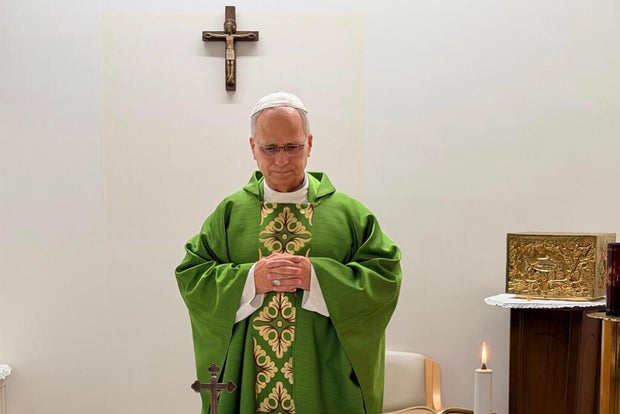
On October 11, the faithful from Unbong Parish and Inwol Mission Station (Namwon, Diocese of Jeonju) are celebrating Mass at the summit of Mt. Jirisan’s Cheonwangbong Peak to pray for the success of the 2027 Seoul World Youth Day (WYD). (Photo courtesy of Seong Gi-chang) Taken from the Catholic Korean Times.
Noon, October 11, at the summit of Cheonwangbong Peak, Mt. Jirisan. After a six-hour hike, the faithful reached the peak—1,915 meters above sea level—and gathered around a makeshift altar created by spreading a white cloth over a rock. Although they were dressed in hiking gear and sat in various postures, their demeanor was solemn as they clasped their hands in prayer. There was only one reason they had climbed to Cheonwangbong: to pray for the success of the 2027 Seoul World Youth Day (WYD) and for the youth.
Twenty-four faithful from Unbong Parish in Namwon (Pastor: Fr. Benedict Jeong Cheon-bong) and its affiliated Inwol Mission Station celebrated Mass at the summit of Cheonwangbong Peak. In his homily, Father Jeong Cheon-bong said, “Today, we are offering Mass here—at the place closest to the heavens—with earnest hopes,” and urged the congregation, “Let us pray that young people, the future of the Church, may place God at the center of their lives and live out their faith, even amidst the busyness of the world.”
Located near the entrance to Baraebong Peak on Mt. Jirisan, the parish is a small community where most parishioners are over the age of 70; currently, there are no young parishioners at all. While parishes across the country are preparing homestays and youth programs ahead of World Youth Day (WYD) in Seoul, this parish faces challenges in participating in such ways due to its aging population and the absence of young members.
Yet, they could not simply regard this global festival of faith for young people as irrelevant to them. Father Jeong and the parishioners pondered how they—given their circumstances—could contribute to the WYD preparations, and the idea that came to mind was Cheonwangbong Peak. They decided to ascend to the place closest to the sky and pray together for the youth.
The parishioners began their hike at dawn. The climb to the summit was no easy feat for the elderly members. There were heart-stopping moments of slipping and falling, and some struggled with knee pain and physical exhaustion. Whenever this happened, they slowed their pace and waited for those who had fallen behind. By pushing and pulling one another, they ascended step by step and finally reached the summit.
Upon reaching Cheonwangbong, the parishioners prayed with their thoughts focused first on the young people participating in Seoul WYD, rather than on their own hardships. Although the parish has no young members, their heartfelt desire for young people to discover the joy of faith and draw closer to God was no different from that of any other parish. Lee Ja-hwa (Flora), head of the parish’s Committee for the Souls in Purgatory, said, “I had been worried because of my bad knees, but I decided to join because the significance of celebrating Mass at the summit—while praying for the successful hosting of Seoul WYD—was so great.” She added, “The Mass at Cheonwangbong Peak itself was truly moving.”
After the Mass, the parishioners spent the night at the Jangteomok Shelter and descended the mountain on the afternoon of the 12th. This two-day hiking and Mass pilgrimage was a special journey through which a small parish community—devoid of any young adult members—contributed to Seoul WYD in its own unique way.